Jiu-Jitsu for Bullying: What Parents Need to Know (Research-Backed)
One in five U.S. students reports being bullied at school, according to the National Center for Education Statistics. Another large share witnesses it daily without being targeted directly. The effects — academic, emotional, social — are well documented and often follow children into adulthood.
Brazilian Jiu-Jitsu keeps being recommended as an intervention. Parents walk into our academy with a child who is being bullied and ask: Will this help? Our honest answer is almost always yes — but the reasons why are worth understanding before you enroll.
This article is the research-backed version of that conversation. What BJJ actually does for bullied kids, what the research says, what it doesn't do, and how to know if your child is a good candidate.
The two-part effect
BJJ helps bullied kids in two distinct ways that work together. Both matter; neither alone is the full answer.
Part 1: Physical preparedness
Almost all physical bullying involves grabbing, pushing, pinning, or dragging. It happens at close range, often on the ground, and almost never involves skilled striking. This is exactly the environment BJJ is designed for.
A kid who has trained BJJ for six months has learned:
- How to keep their balance when pushed
- How to fall safely if pushed down
- How to create space between themselves and someone pressing into them
- How to get off the ground if someone is on top of them
- How to stay calm in close physical contact
That skill set neutralizes the mechanics of most schoolyard bullying. The bullied kid becomes physically much harder to bully — not through aggression, but through control.
Part 2: The confidence shift
This is actually the bigger effect, and it's the one backed by the most research.
A 2023 study published in the International Journal of Environmental Research and Public Health examined children who trained martial arts consistently for six months. It found measurable improvements in self-esteem, emotional regulation, and social confidence. The effect was strongest in children who had entered the program anxious, socially withdrawn, or low in baseline confidence — which describes most bullied children accurately.
The confidence BJJ builds is not bravado. Kids don't leave class wanting to fight. What they leave with is a quiet sense that they can handle physical pressure without panicking. That internal shift changes how they carry themselves, and bullies — who read body language constantly for easy targets — detect it immediately.
The pattern we see at our academy, over and over: a bullied kid starts BJJ. Within eight weeks, their posture changes. They make eye contact. They stop flinching at unexpected movement. Within six months, the bullying has almost always stopped — usually without a single physical confrontation.
What the research actually says
Beyond the 2023 confidence study, here's what the published evidence supports:
- Injury rates in kids' BJJ are among the lowest of any martial art. A 2014 study in the Journal of Sports Science and Medicine found BJJ's injury rate significantly lower than football, soccer, and basketball. The absence of strikes is the key — no concussions, no impact injuries, minimal risk of breaks.
- Regular martial arts training reduces aggression rather than increasing it. This is the opposite of what many parents initially fear. A meta-analysis of 15+ studies on youth martial arts consistently found that children who train develop better impulse control and lower aggression scores, not higher.
- Emotional regulation improvements transfer to non-martial contexts. Kids who learn to stay calm under physical pressure in BJJ class apply the same skill to academic stress, social anxiety, and household conflict. Parents notice this within 2-3 months.
- The effect is dose-dependent. Twice-weekly consistent training for 6+ months produces the effects cited above. Once-a-week casual training produces much weaker effects. Three times a week is where meaningful change compounds.
What BJJ does NOT do
Parents deserve honesty on both sides. BJJ is not a magic bullet, and marketing that suggests otherwise is misleading. What BJJ won't do:
- Fix severe cases of verbal or cyber bullying overnight. Physical confidence affects some types of bullying more than others. A child being excluded from a friend group will benefit from general confidence growth, but the social dynamic isn't solved on the mat.
- Replace professional help for serious mental health impacts. Kids experiencing anxiety, depression, or trauma from bullying often need therapy in addition to physical activity. BJJ is supplementary, not substitutive.
- Make your kid want to fight back. A healthy BJJ culture specifically teaches kids NOT to escalate. If your expectation is that your child will "finally stand up" to a bully, you may be disappointed — they'll probably just stop being a target.
- Produce results in two weeks. The confidence shift takes 6-12 weeks of consistent training to appear. Parents looking for instant transformation will be frustrated.
Is my child a good candidate?
BJJ helps most bullied kids. It helps some dramatically more than others. These are the signs your specific child is likely to benefit:
- They can follow adult instructions from a non-parent. This is the threshold for any productive class time.
- They are capable of handling losing at a game without complete meltdown. BJJ involves losing constantly in the early months. Kids who can't handle losing will struggle until they can.
- They have some basic physical confidence. Not athleticism — just willingness to move their body. Kids who refuse any physical activity (not out of defiance, out of true anxiety) often need a gentler starting point like kids yoga before BJJ.
- The bullying is relatively recent or contained. Kids who have endured years of severe bullying often benefit more from therapy + BJJ in combination than BJJ alone.
How to start (without making it a big deal)
One of the most important things parents sometimes get wrong: don't explicitly frame BJJ as the solution to the bullying. If you tell a 9-year-old "we're enrolling you in this because you're being picked on at school," you put enormous pressure on the class to fix their worst problem — and you implicitly blame them for the bullying.
What works better:
- Frame it as a new activity you think they'll enjoy, that involves other kids their age
- Start with a free trial with no commitment — "let's see if you like it"
- Let them build the relationship with the class organically
- Don't mention the bullying for at least the first month unless they bring it up
The transformation happens quietly in the background. When it happens, they'll know. You'll know. No one needs to announce it.
What we see at Winners, specifically
Our academy has trained many kids who came in being bullied. Some of their journeys are public — Jade Ghezal's story is one we've documented (with her and her family's permission) and has been featured in press. She started at seven as the only girl in a class of older boys, having been targeted by classmates in second grade. Today she's a competitor and a youth coach at our academy, helping other bullied kids the way her coaches helped her.
Most of the other stories stay private — as they should — but the pattern is consistent: kids come in unsure of themselves, kids leave carrying themselves differently, bullying situations quietly resolve over a few months, families stay at the academy for years.
How to evaluate a kids' BJJ program for this purpose
If you're specifically looking for BJJ as a tool for a bullied child, look for:
- A culture that celebrates effort, not just winning. Kids who are already struggling don't need another environment where only the winners matter.
- Coaches who know every kid by name. A child who feels invisible at school needs to feel seen at the academy.
- Mixed-ability classes where newer students aren't isolated. Kids at the same belt training together, not an assembly line.
- A coach who will talk to you honestly about your child's specific situation. Not a sales pitch. A real conversation about what you're hoping for and what's realistic.
- Longevity and stability. Your child will need the same coaches and teammates over years, not a revolving door.
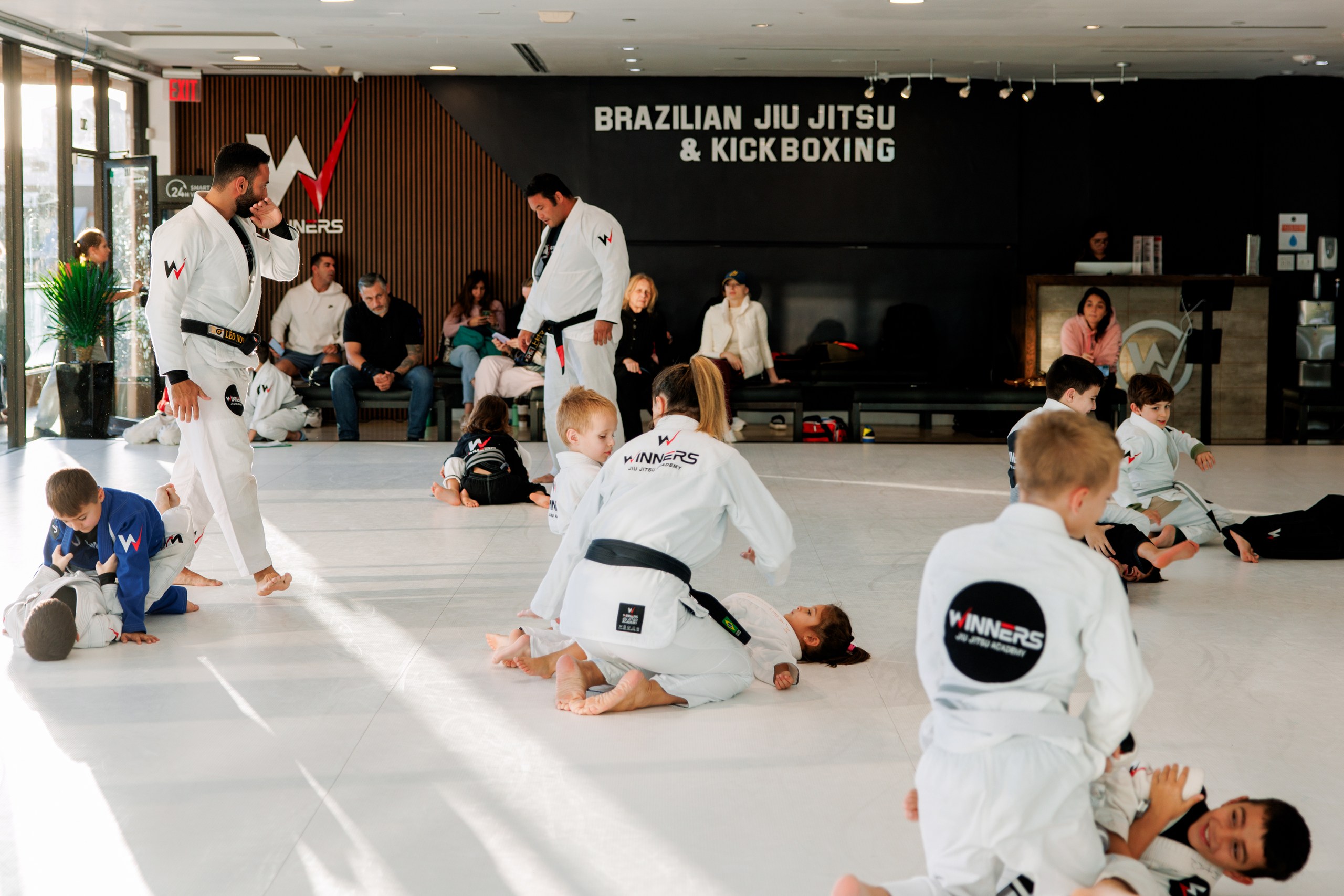
At Winners Jiu-Jitsu Academy, our kids programs are designed around this. Classes are age-grouped (3–4, 5–7, 8–12) so kids train with peers. Class sizes are capped. Coaches stay — most have been here more than five years. And we'll have a real conversation with you about what you're hoping to see, before we talk about pricing.
If you're considering BJJ for a child who is being bullied, the first class is free. Come watch, let them try, see how they respond. Then decide.